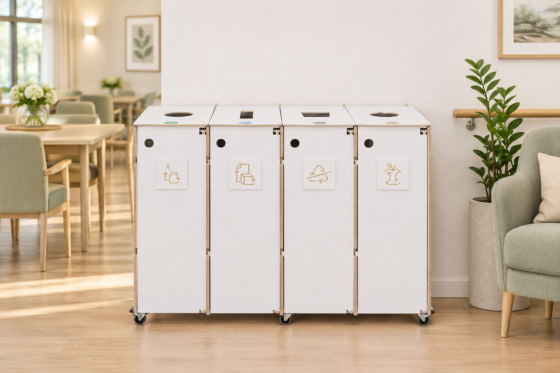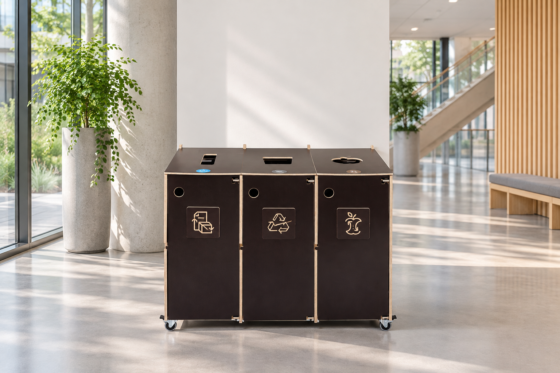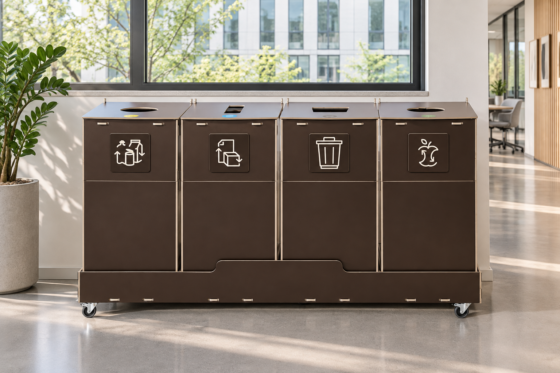
Library bins are quiet, yet they decide whether your recycling works. In audits, leftover coffee and food often spoil library paper streams. This guide covers streams, quiet-zone placement, accessible heights, staff areas and emptying schedules for public and academic libraries.
Library waste zones at a glance
| Zone | What lands in the bin | Setup that works |
|---|---|---|
| Entrance, café corner, vending | Cups, bottles, packaging, food, liquids | Full sorting station plus a liquid-pour point, emptied at least daily |
| Reading rooms and quiet floors | Paper, wrappers, a few drink containers | Few stations at floor edges and exits, not at every table |
| Learning commons, group rooms | Drinks, snacks, printouts | Paper, packaging and mixed waste side by side |
| Children’s area | Paper, packaging, tissues | Two or three fractions, low openings, easy-to-clean surfaces |
| Staff areas | Office paper, kitchen waste, delivery cardboard | Sorting station, lockable bin or shredder for personal data |
| Back-of-house | Weeded books, packaging, old equipment | Dedicated routes agreed with your waste contractor |
What a library actually throws away
Do not assume paper is your biggest stream. Audits of university libraries show how much the split varies. In a 2014 Queen’s University audit of Stauffer Library, organic material made up 56.58% of the audited waste, plastics 21.71% and paper 18.75%. In a University of Guelph audit, the library’s garbage stream was 36.49% paper, 29.59% plastics and 26.85% organics.
The bigger problem is contamination. A 2011 student audit of the Killam Library’s four-bin system found average contamination of 30.62% in paper bins, 44.33% in plastic bins and 42.88% in garbage bins. At University College Cork’s Boole Library, the recycling rate was 5–10% and effectively zero during semester. Liquid from unfinished coffee cups was one of the biggest contaminants.
Run your own audit before you buy anything. Queen’s method is easy to copy: collect every bag for 24 hours, tag each with the area it came from, then sort and weigh. One weekday and one weekend sample show where each stream is generated.
Set up the streams
Start from what your waste contractor actually collects, not from the longest list of fractions. For most libraries that means:
- Paper and cardboard, kept clean and dry.
- Packaging, such as plastic, metal and cartons.
- Bio-waste, only where there is a café, staff kitchen or events with food.
- Mixed waste, for everything else.
- Deposit packaging or glass, where your market collects them separately.
Handle liquids at the source. The University of Portsmouth Library asks users to empty leftover drinks into dedicated liquid-waste bins, put food and teabags in a separate section, and only then recycle the empty cups and bottles, because recycling has to stay dry. Copy that: a pour-out point beside the sorting station is cheaper than a contaminated paper load.
Legal note. In the EU, the Waste Framework Directive has required separate collection of at least paper, metal, plastic and glass since 2015. Bio-waste had to be separated and recycled at source or collected separately by 31 December 2023, and textiles by 1 January 2025. The Packaging and Packaging Waste Regulation (EU) 2025/40 has applied since 12 August 2026. Member States implement the details differently. Sortaider’s school guide notes, for example, that Estonia requires bio-waste separation where a site produces more than 10 kg a day. Check your national and municipal rules and your contractor’s stream list. Our EU recycling legislation guide and bin colour coding guide explain how markets differ.
Place bins for quiet spaces
In a library the aim is fewer, better-placed stations rather than a bin at every desk. BS 8233 guidance, as summarised by acoustic consultants, gives 30–35 dB LAeq as a guide value for library reading areas. It is guidance, not a legal limit. At that level, lid clatter, bag changes and cart noise stand out.
Harvard Law School’s refreshed Reading Room shows the principle. It has three waste stations, one at each end and one by the centre doors, and no bins at the tables.
Apply it like this:
- Pair every general waste bin with its recycling stream. Sortaider’s placement guide calls this the 1:1 rule. A lone bin collects everything.
- Keep stations within 10–15 metres of where waste is created. Past that distance people use the nearest bin.
- Put stations at transitions: entrances, café exits, stairwells, lift lobbies and the edges of quiet floors, so users dispose of waste on the way out.
- Choose the lid by fraction. A hole opening lets people drop waste in without touching the lid, which suits dry paper and packaging in quiet areas. A closed lid hides contents and keeps odours in, which suits food waste.
- Schedule noisy work outside opening hours. Emptying, bag changes and bin moves belong before opening or after closing.
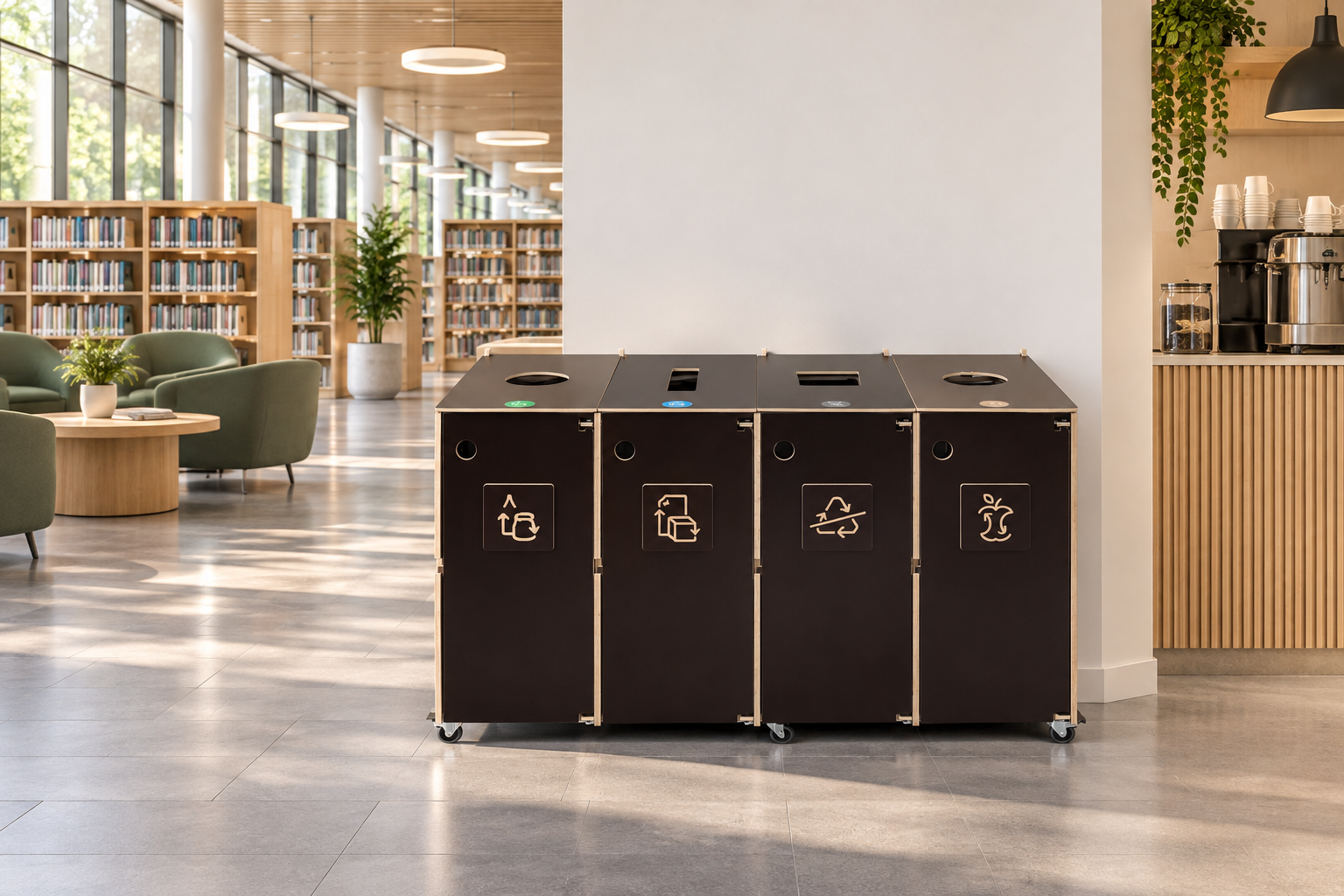
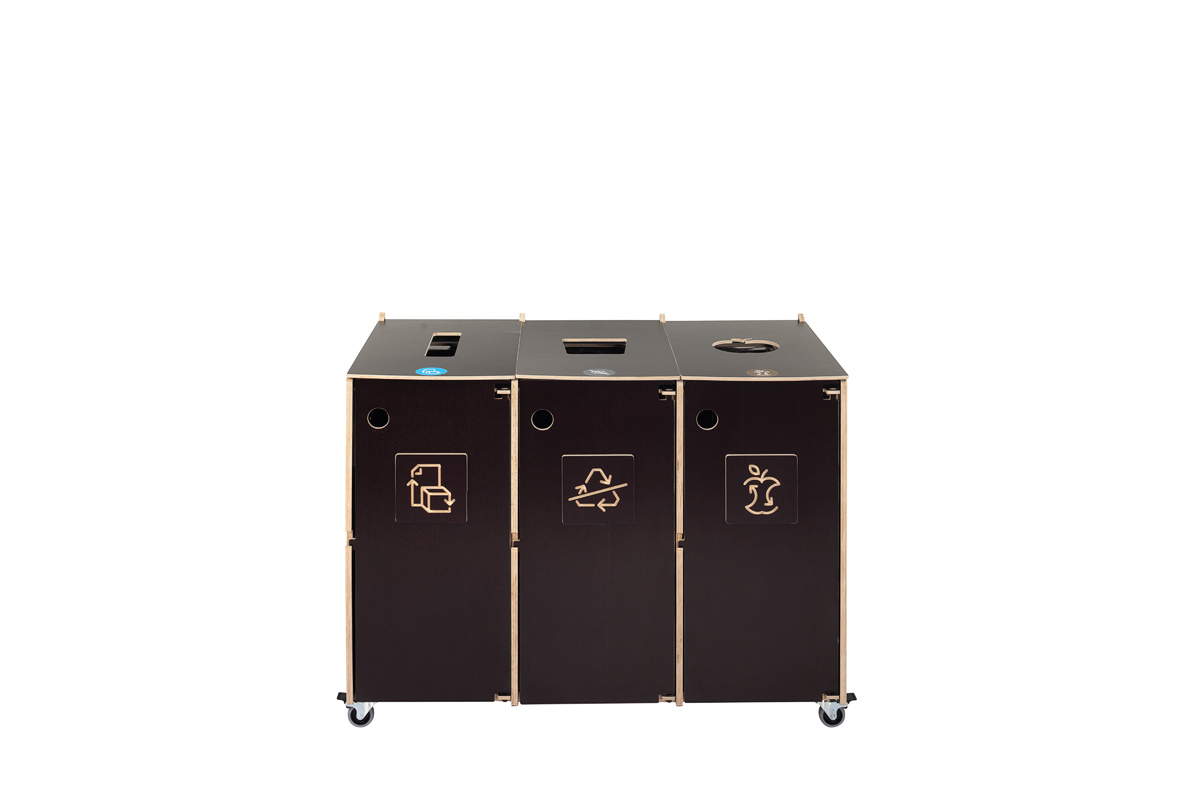
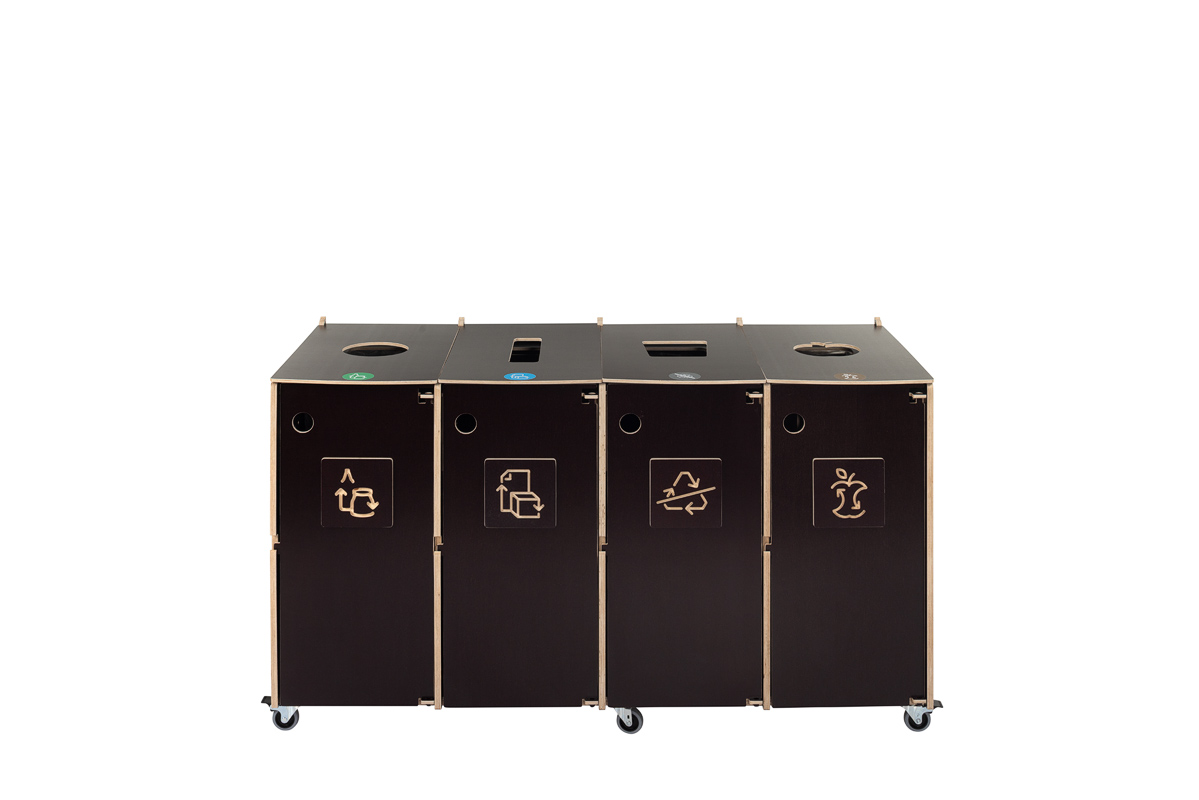
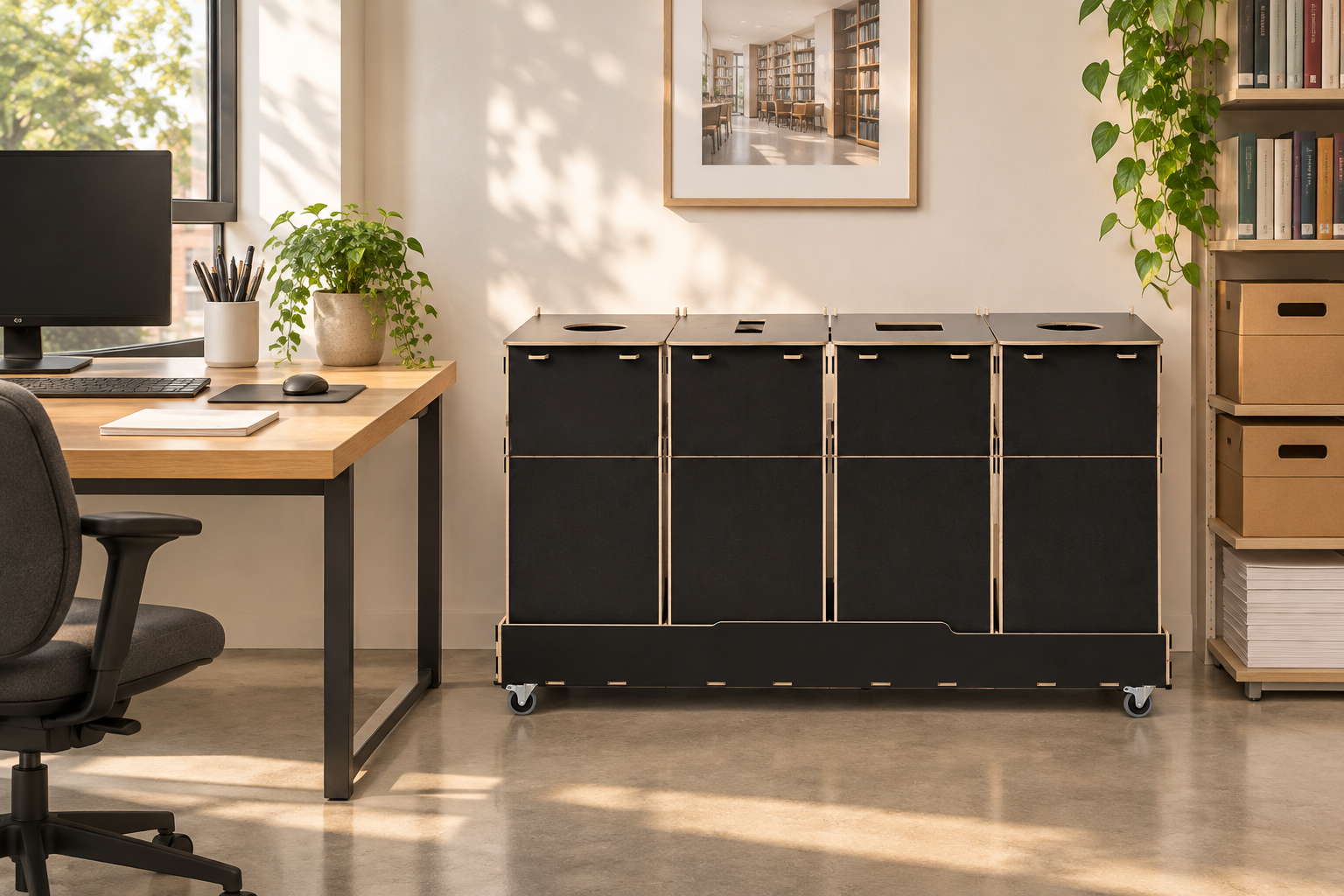
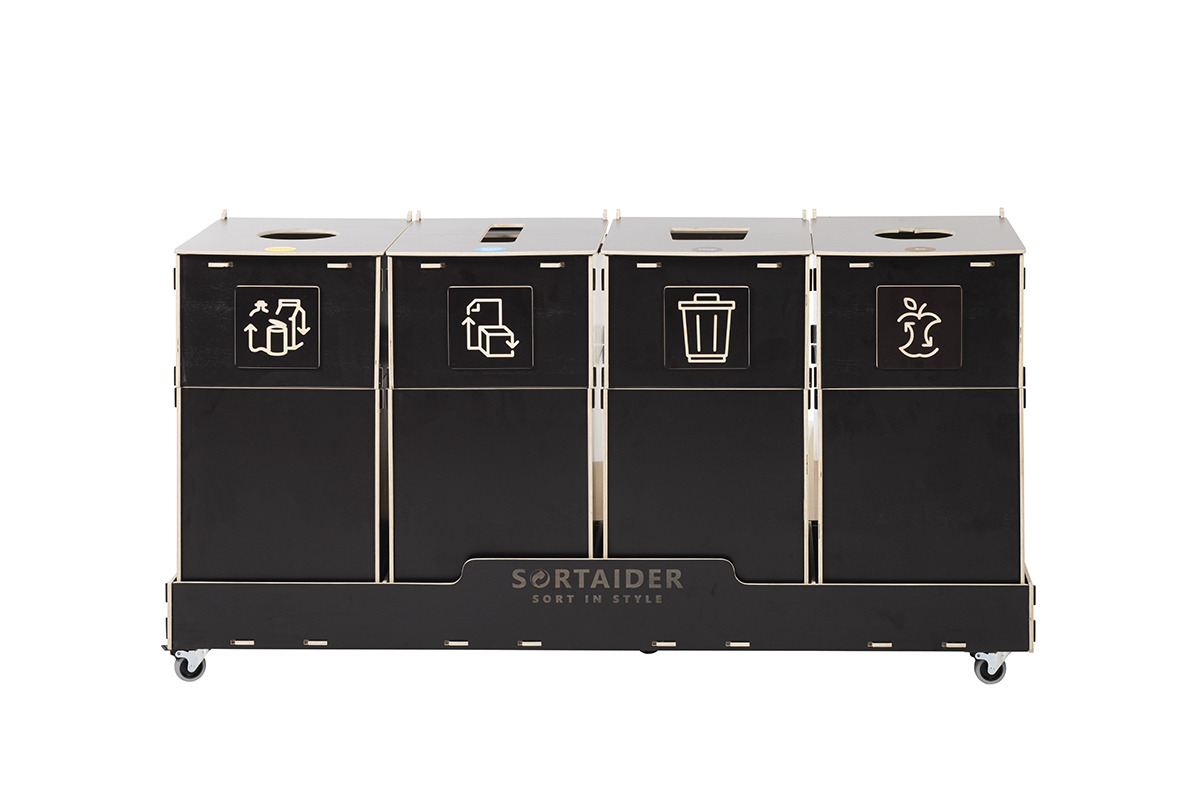
For busy indoor entrances and café corners, a multi-fraction station such as Ecolong suits the job. It offers 60 or 90 l compartments for 2–5 fractions. Each fraction can use a Longopac continuous bag, a standard bag or no bag. Bagless collection suits clean paper and cardboard.
The wider guide to recycling bin placement covers zone layouts in more detail.
Make bins accessible to every visitor
Libraries serve wheelchair users, older readers and children, so bin accessibility is part of the plan from the start. The 2010 ADA Standards for Accessible Design in the US are a widely used benchmark:
- Operable parts such as lids, openings and handles sit 15–48 inches (38–122 cm) above the floor.
- Clear floor space of at least 30 × 48 inches (76 × 122 cm) lets a wheelchair user approach from the front or side.
- Routes stay at least 36 inches (91 cm) wide.
- Where bins are provided for waste paper or other purposes, at least one of each type must comply.
The ADA is not European law. EN 17210 covers accessibility of the built environment in Europe, but its summary gives no bin-specific figures, so check your national building code. The ADA values still give you a measurable starting point. Measure the opening height of the bin you are considering, not only the body height.
Two library-specific points: never park a station in a narrow aisle between shelving, and in the children’s area keep openings low. The ADA treats children’s reach ranges separately and only as advisory guidance.
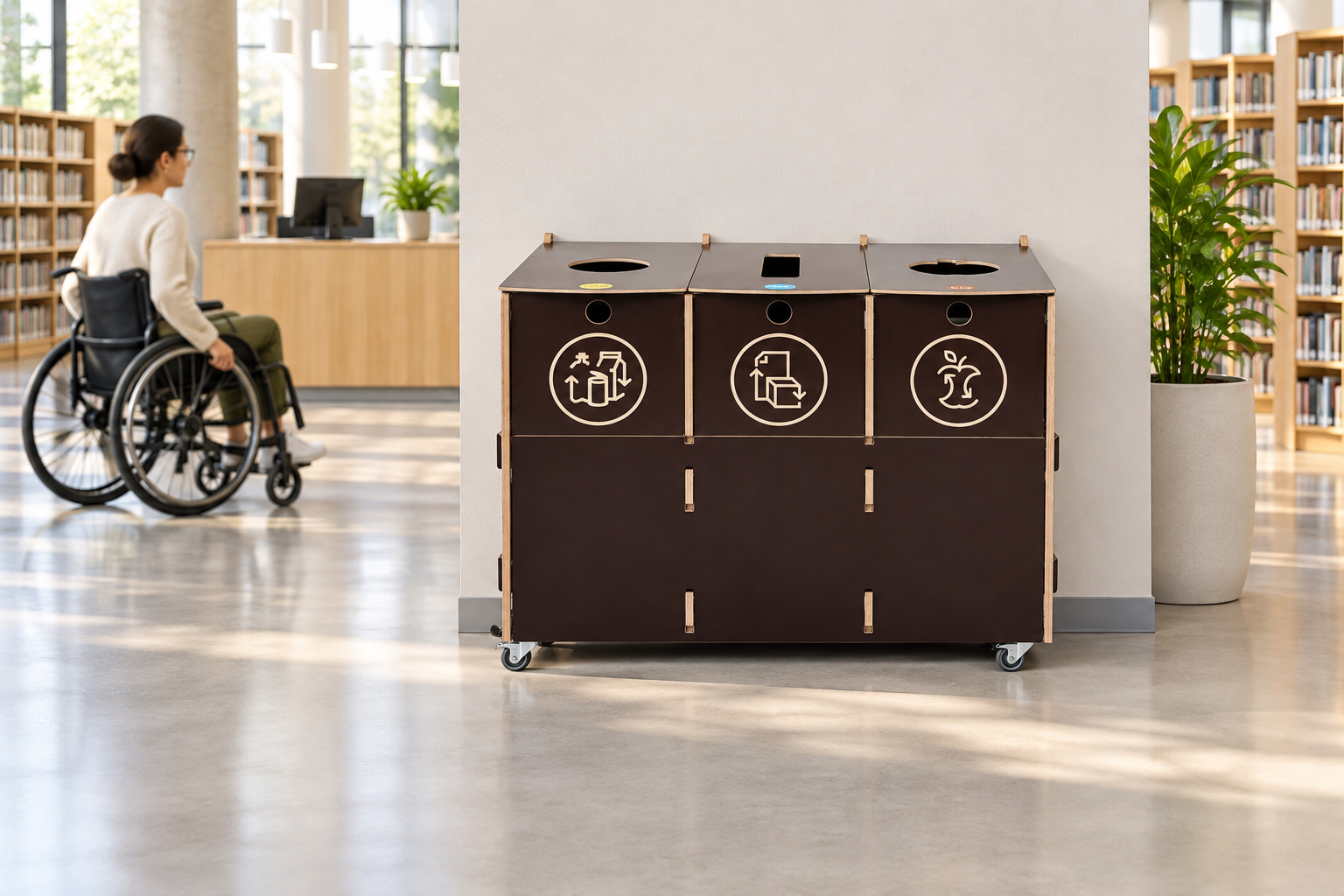
In lobbies and public corridors, a station with smooth surfaces and removable inner containers, such as the Container series, keeps cleaning simple. It comes in 3–5 fractions of 40 l each.
Staff areas, confidential paper and weeded books
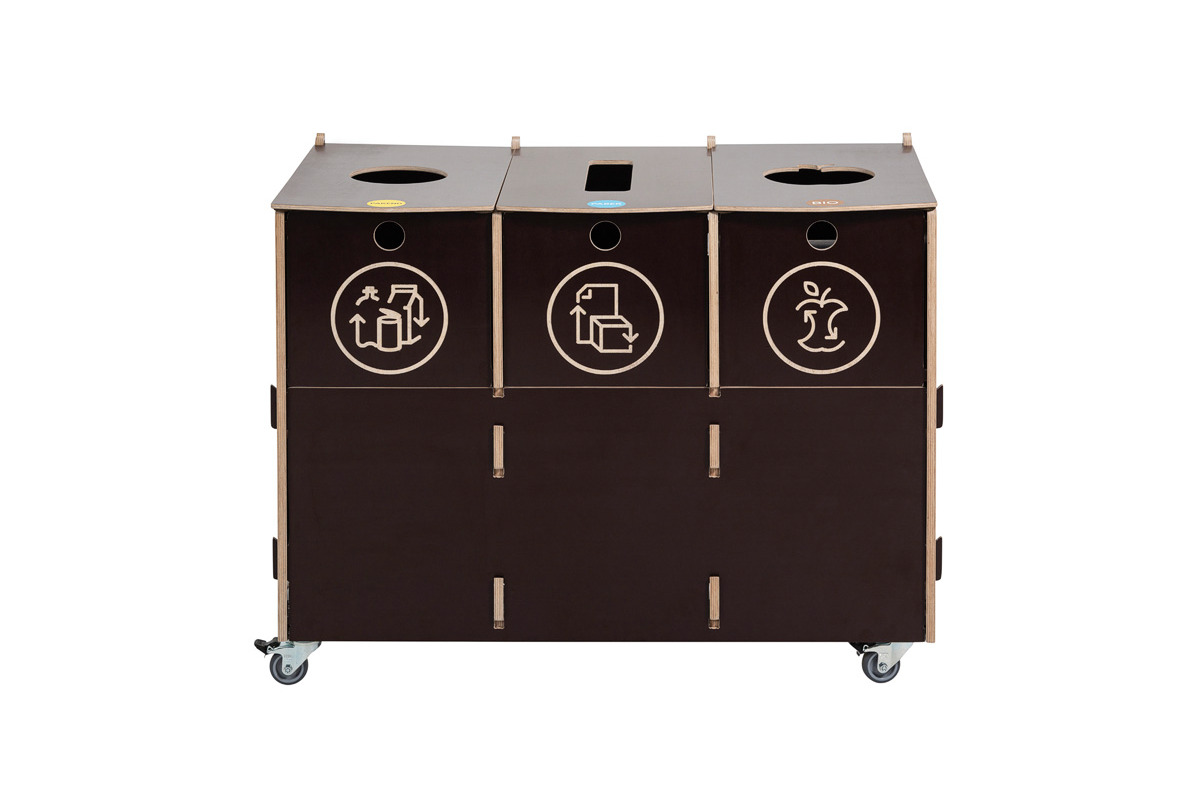
Staff sorting. Back offices and staff kitchens behave like offices: office paper, packaging, food waste. A compact modular station of 4 fractions fits there. Keep the same fractions and pictograms as in public areas so staff and visitors learn one system. Our office recycling setup guide goes deeper.
Confidential paper. Loan and membership records are personal data. The UK data protection regulator (ICO) recommends locked waste bins for paper containing personal information, plus in-house or third-party cross-shredding or incineration. Data protection law also expects you not to keep personal data longer than needed. An open paper bin in the staff area is not enough for printed reservations, registration forms or ID copies.
Weeded books. Libraries typically sell, donate or recycle withdrawn items, so treat weeding as a project, not as daily waste.
- Offer reusable books to Friends sales, free tables or charities first.
- Do not put them in public paper bins. Bound books do not behave like loose paper at the recycling plant. Kent County in Michigan notes that books act like bricks on the sorting line.
- Recycling rules differ locally. The US EPA says paperbacks can be recycled as they are and hardcover covers should be removed. Bromley Council in London says hardback covers cannot be recycled.
- Agree the route with your contractor or a paper recycler before the first pallet leaves.
Also plan for public computers and equipment: see our guide to WEEE recycling regulations.
Hygiene, pests and fire safety
A library has a particular reason to care about food waste: pests are attracted to paper. The Texas State Library and Archives Commission notes that cockroaches, silverfish, mice and rats are often drawn to the adhesives and starches in paper-based collections. Preservation guidance from Cornell and the University of Illinois asks libraries to keep food out of collection areas and to empty food waste receptacles daily. Conservation guidance also warns that corrugated cardboard can harbour silverfish. Flatten delivery boxes and move them out of storage rooms quickly.
Practical rules:
- Empty bio-waste daily, and mixed waste from café areas at least daily.
- Keep bins away from the shelves and out of the stacks, and do not store full bags inside the building overnight.
- Clean inner containers on a schedule. Our bin cleaning guide and odour prevention guide cover products and intervals.
On fire safety, an older library code of practice (Indian Standard IS 11460, 1985) recommends non-combustible waste-paper bins, preferably with self-closing lids, emptied at the end of each working day. It is a dated, non-European source, but the principle holds. Plywood is combustible, so ask your fire officer which bin materials your building code allows in each zone, and keep wooden bins out of stack and archive areas.
Size bins and set emptying frequency
Size each compartment from the audit, not from the bin’s litres. A simple method:
- Measure litres per day per stream from your audit.
- Divide by the number of stations serving that stream.
- Choose a compartment that fills to about two-thirds at the chosen emptying interval.
Illustrative example with assumed numbers: say your audit shows 120 l of packaging a day, split over 3 stations. That is 40 l per station. A 60 l compartment emptied daily sits at about two-thirds full. A 40 l compartment would overflow on busy days.
Frequency follows the stream. Café-adjacent and bio-waste stations need daily attention. Quiet-floor paper stations can be emptied less often, with the interval set by your audit. Review after one semester or season, since academic libraries peak during exams. See our guide on how often to empty recycling bins for more.
If you run a wider site, our guides on university campuses and museums cover systems that span many buildings or exhibition spaces.
Start with a 24-hour audit of one floor this month, then match the result to a station from our recycling bins range. If you want a second pair of eyes on placement, ask Sortaider’s team to match models to your floor plan.