Two green logos, one wooden product, and no obvious difference. FSC and PEFC both certify forests and supply chains, but they differ in how the rules are set, what a label promises and which documents prove it.
FSC vs PEFC at a glance
| FSC | PEFC | |
|---|---|---|
| Rule-setting | Global Principles and Criteria, adapted into national or interim standards | International benchmarks; national systems are assessed and endorsed |
| Governance | Three chambers (environmental, social, economic), each with 33.3% of the vote | Bottom-up; members vote in a General Assembly, national members get 1–7 votes |
| On-product labels | FSC 100%, FSC Mix, FSC Recycled | PEFC Certified, PEFC Recycled |
| Label threshold | Mix label (percentage system) needs at least 70% certified or post-consumer recycled input | Certified label needs at least 70% PEFC-certified material |
| Non-certified input | FSC Controlled Wood (five excluded categories) | PEFC Controlled Sources (negligible-risk due diligence) |
| Public lookup | FSC Search | PEFC Find Certified |
If you only remember one thing: a label tells you the claim, but only the supplier’s certificate and invoices prove it. The rest of this guide shows how to check both.
How the two schemes are built
FSC (Forest Stewardship Council) sets one global framework. Its ten principles cover legal compliance, workers’ and Indigenous Peoples’ rights, and conservation values, and national standards translate them to local conditions. Decisions sit with members in three chambers with equal voting weight, which is meant to balance the interests involved.
PEFC (Programme for the Endorsement of Forest Certification) works as an umbrella. It does not write every forest standard itself. National systems, developed by local stakeholders, are assessed against PEFC’s international benchmarks and then endorsed.
In practice, both schemes certify forest management and also certify the supply chain, which is called chain of custody (CoC). CoC certification covers every company that handles the wood after the forest: sawmill, plywood mill, bin manufacturer. Without it, a forest certificate says nothing about the product you buy.
Which scheme dominates where
Global reach differs. PEFC reports about 71% of the world’s certified forest area, and the Nordic Forest Statistics 2026 report puts 2025 totals at 296 million hectares for PEFC and 173 million for FSC.
For Northern Europe, the same report shows a split:
- Finland: PEFC 75% of forest area, FSC 12%.
- Norway: PEFC 60%, FSC 6%.
- Denmark: PEFC 56%, FSC 36%.
- Sweden: FSC 71%, PEFC 59%. Many Swedish areas hold both certificates, so don’t add the figures.
- Estonia: FSC says 60% of the country’s forest is FSC-certified.
A buyer in Helsinki and one in Tallinn may therefore find different schemes more common among local suppliers. Both are accepted widely, so choose based on documentation quality, not on a general “better” label. Critics also disagree about stringency: WWF Finland, for example, argues that PEFC in Finland does not in practice prevent logging of old-growth forest. Read such criticism as one input; it concerns forest rules, not whether a given invoice is valid.
What the labels actually mean
FSC labels
- FSC 100%: all material comes from FSC-certified forests.
- FSC Recycled: the product is made from recycled material.
- FSC Mix: certified material mixed with recycled material and/or FSC Controlled Wood.
Controlled Wood is the detail that surprises buyers. It is not from FSC-certified forests. It is virgin wood that passed a due-diligence check against five unacceptable sources: illegal harvesting, violation of traditional and human rights, forests where high conservation values are threatened, forests being converted to plantations or other use, and forests with genetically modified trees. FSC itself says Mix products must not be described as made from “well-managed forests” without mentioning the other sources.
Under the FSC percentage system, a Mix label needs at least 70% certified (or post-consumer recycled) input. The percentage is calculated as claim-contributing input divided by total forest-based input, over a period of up to 12 months unless the certification body approves otherwise.
PEFC labels
- PEFC Certified: at least 70% of the forest- and tree-based material is PEFC-certified; any remainder must come from PEFC Controlled Sources.
- PEFC Recycled: only recycled forest- and tree-based material.
PEFC Controlled Sources mean material that the company’s due-diligence system has assessed as negligible risk of coming from controversial sources.
The label covers the wood, not the whole product
Both schemes judge forest-based material only. PEFC states that its label does not apply to plastic, metal or glass parts. FSC says its label may not make a partial claim, so every permanent forest-based part must be covered, while non-forest parts are excluded from that requirement.
For a plywood bin with steel castors and a plastic lid insert, that is normal. It does mean a label says nothing about the metal and plastic components or the glue and finish.
How to check chain-of-custody documentation
A logo on a product page is a claim. These steps turn it into evidence:
- Get the supplier’s certificate code and licence code. FSC certificate codes follow the pattern ACB-COC-000000, and the trademark licence code looks like FSC-C######. PEFC licence numbers look like PEFC/XX-XX-XX.
- Look the company up in the public database. Use FSC Search for FSC and PEFC Find Certified for PEFC. You can enter just part of a code or name in FSC Search.
- Check status and scope. The certificate must be valid today, and the product type, such as plywood, must sit inside the certified product groups. A valid certificate for sawn timber does not cover plywood.
- Match the name on the invoice. If a retailer sells finished, labelled goods unchanged, PEFC says it doesn’t need to be certified itself. Then check the manufacturer named on the label or documents instead.
- Read the invoice or delivery note. FSC requires sales documents for FSC-claimed products to carry a product description, quantity, the seller’s FSC certificate code and the claim. PEFC guidance expects supplier and product identification, quantity and delivery identification, and, for claimed inputs, the PEFC customer, the claim and the supplier’s certificate number.
- Repeat on a schedule. FSC standards oblige certificate holders to verify suppliers’ certificate validity and product-group scope regularly in the database. Do the same for recurring purchases, because certificate status can change.
FSC adds a second control that buyers can’t see: certification bodies and the accreditation body ASI run transaction verification, comparing the sales and purchase records of trading partners to spot mismatched volumes.
Worked example: reading a plywood invoice
Say your plywood bin supplier sends an invoice line: “Birch plywood bin, 20 pcs, FSC Mix Credit, FSC certificate code on document.”
- Good: product, quantity, claim and certificate code are all present. Look up the code and confirm the status and that plywood is in scope.
- Read carefully: FSC Mix Credit is a credit-system claim. It does not mean each sheet physically holds a set share of FSC-certified wood. FSC allows eligible inputs to be mixed, and the quantity sold as Mix Credit is limited by the claim-contributing input the manufacturer holds. FSC Mix 70%, by contrast, is a percentage claim.
- Red flag: only a logo and the words “certified wood”, with no code, no claim and no way to find the company in a database.
If you need a product where every sheet traces to certified forests, ask for an FSC 100% claim. FSC states that these products are processed using the transfer system, which passes the input claim directly to the output.
Certification and the EU Deforestation Regulation
For European buyers, a certificate is useful but is not legal proof. The European Commission lists 30 December 2026 as the application date of the EUDR for large and medium-sized operators and traders, and 30 June 2027 for most micro and small enterprises (as of November 2026).
FSC’s own EUDR material says certification is an input to due diligence, not a substitute. EUDR places the obligation on the operator or trader, and PEFC likewise notes that trading certified products does not exempt companies from their obligations. Treat the certificate as supporting evidence, and keep the geolocation and legality information your own due diligence needs. If you are unsure whether you count as an operator, take legal advice. Our overview of EU recycling legislation covers the wider rules for facilities, and the guide on whether plywood is sustainable shows how certification fits with carbon data.
Which scheme should you ask for?
Use these rules of thumb:
- You want the strictest traceability on paper: ask for FSC 100% or PEFC claims with documented certificate scope, and accept Mix or “x% certified” claims only when you understand the share.
- Your tender or green-building scheme names a label: follow it. Some frameworks accept both. PEFC UK notes, for instance, that the UK government’s timber procurement policy accepts FSC or PEFC supply with at least 70% certified content as evidence of legal and sustainable sourcing, while other tenders name one scheme.
- You buy regionally in Finland or Norway: PEFC supply is likely to be larger, so insisting on FSC may narrow your options. In Sweden or Estonia, FSC is common.
- You can’t verify the supplier: do not accept the claim, whichever logo is shown.
Neither scheme replaces other checks on a product, such as lifetime, repairability and emissions data. The guide to the Ecodesign for Sustainable Products Regulation explains what buyers will be able to ask for in future.
Putting it into practice with plywood bins
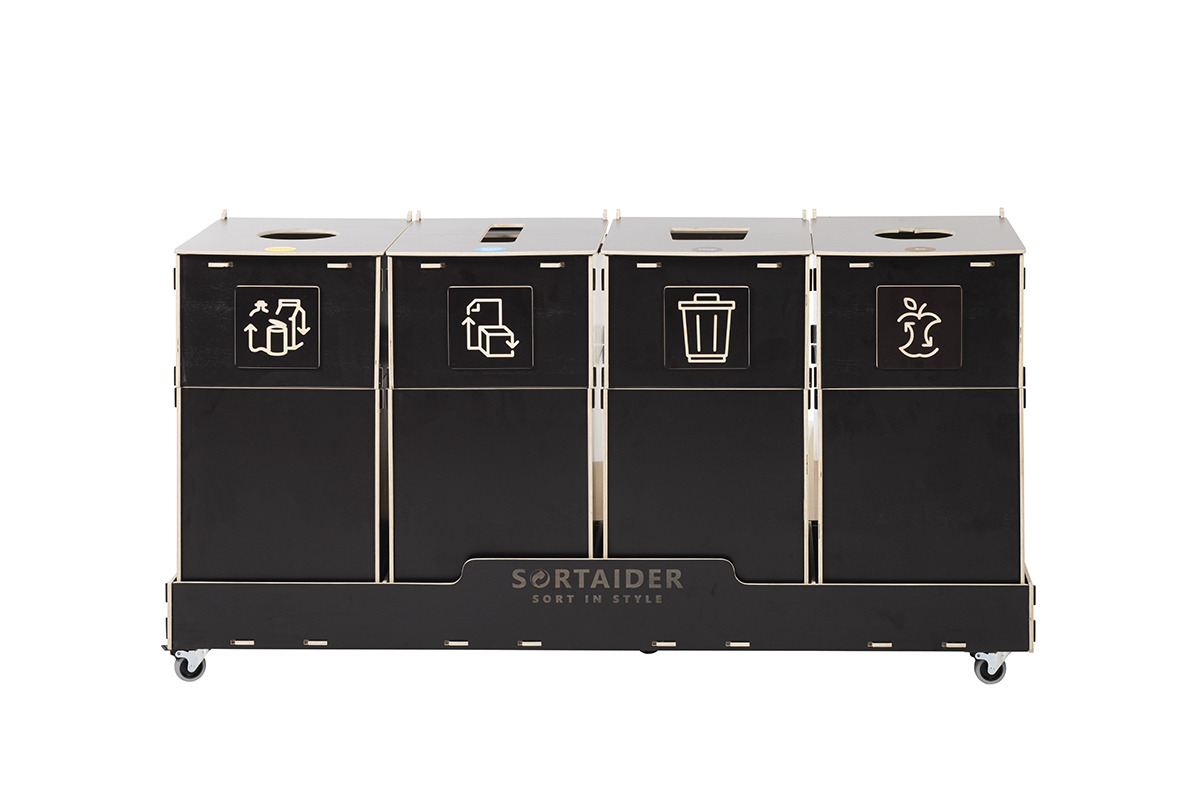
Plywood bins are a good test of everything above, because the wood, glue, finish and metal parts each need their own answer. This article does not claim a certification for any specific Sortaider product. For any bin you consider, ours included, ask for the certificate code, the claim type on the invoice and the certified product group, then check them in the database.
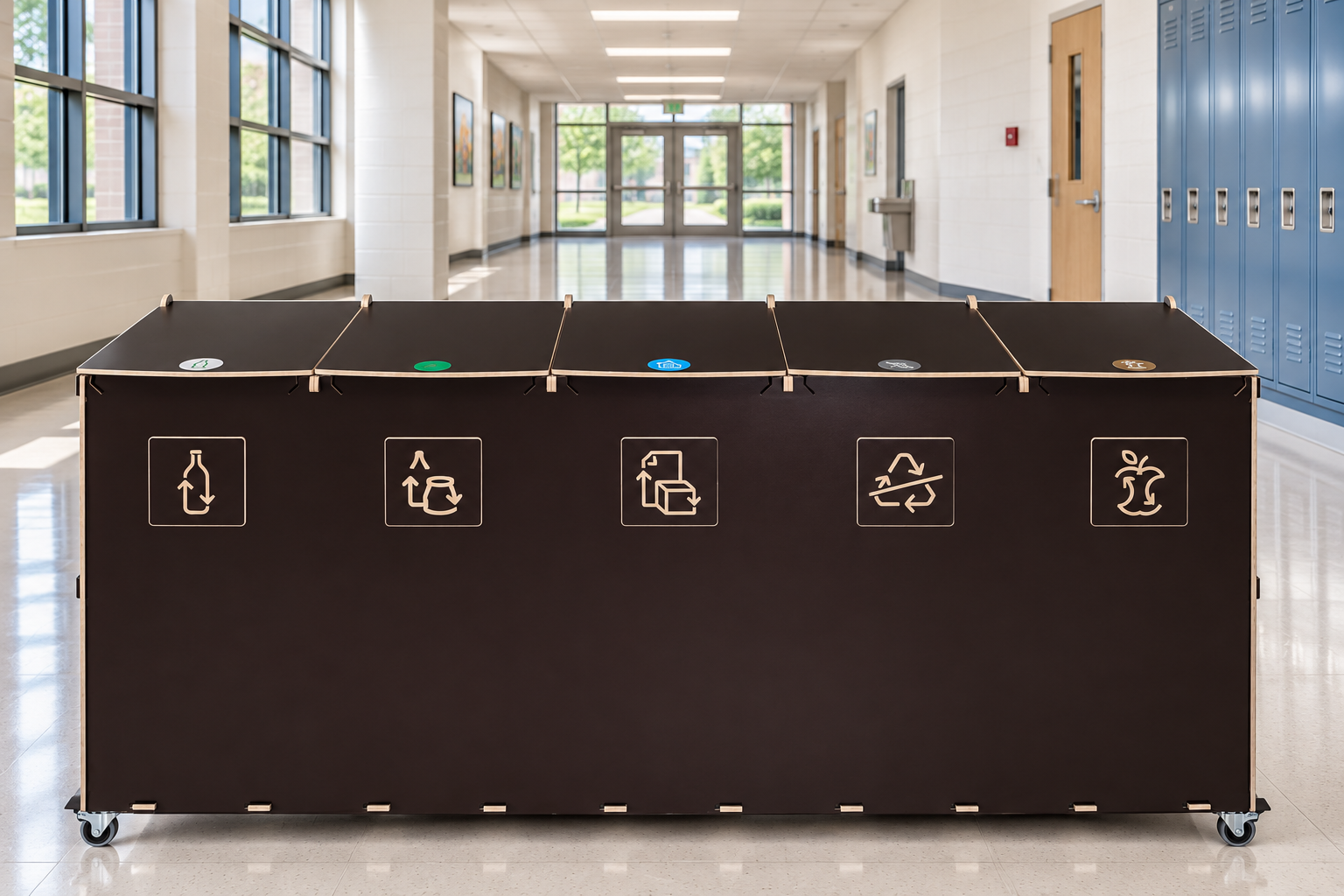
Browse the recycling bins and waste bins ranges, or start with two popular plywood models for offices and schools:

Send your sustainability requirements, such as scheme, claim type and documentation, with your enquiry, and request the supporting documents before you order.