School recycling bins for classrooms, corridors and dining areas
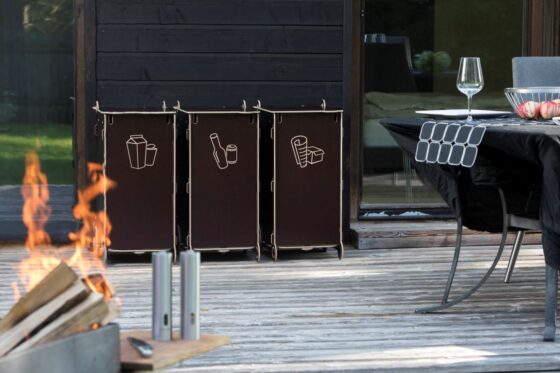
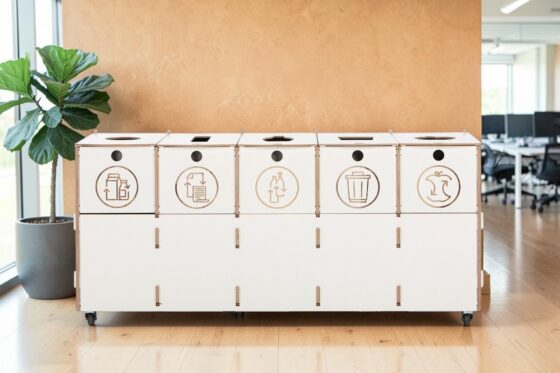
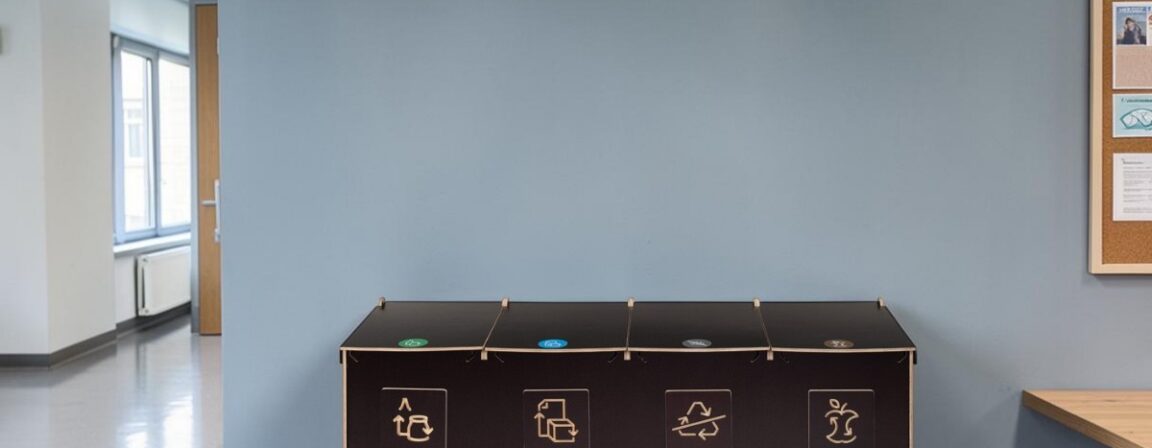
School recycling bins bring together 2–5 waste fractions in one marked sorting point. In the Sorta range the volume of one compartment is 20, 40, 60 or 90 litres. Points can be planned for classrooms, corridors, dining areas, teachers’ rooms and other shared indoor spaces.
Planning starts from what waste fractions are generated in the different spaces, where they are collected in the property and how the sorting point is emptied. This guide helps you determine the waste fractions, the number of compartments, the volume, the location and the markings before choosing an individual Sorta model.
School recycling bins for 2–5 waste fractions
Only the waste fractions that are really collected separately in the property are chosen for the sorting point. The collected fractions can be, for example, mixed waste, biowaste, plastic packaging, cardboard packaging, paper, glass packaging, metal or deposit packaging according to the property’s own waste management system.
Each compartment has one clear name and identifier. A model with two compartments serves two and a model with five compartments at most five separately named waste fractions. If different fractions are collected in different buildings or spaces, each sorting point is determined according to its own place of use.
School recycling bins with 20, 40, 60 and 90 litre compartments
The Sorta range includes eight 20 litre, eight 40 litre, eight 60 litre and eight 90 litre models. Both colours have options for 2–5 waste fractions. The volume is stated as the volume of one compartment, so a four-part 40 litre model, for example, has four separate 40 litre compartments.
The volume is chosen on the basis of the number of users, the actual accumulation of the waste fraction, the space available and the agreed emptying rhythm. All waste fractions do not fill up at the same speed, and a classroom, a corridor or a dining area is not automatically tied to one size class. The dimensioning is checked during use on the basis of actual filling.
School recycling bins are placed where the waste is generated
In a classroom the sorting point is placed close to the place where the chosen waste fractions are generated, but the bin must not narrow the passageway or prevent the use of the furniture. In a corridor and in a shared space the point should be visible without reaching into the exit route. The waste fractions of the dining area are determined together with the kitchen and the waste management of the property.
Space is left around the bin for using the lid, changing the waste sack, cleaning the surfaces and for the agreed maintenance route. The Sorta sorting station has lockable front wheels. The wheels are locked at the place of use and released only for controlled moving.
School recycling bins are marked and maintained according to a consistent plan
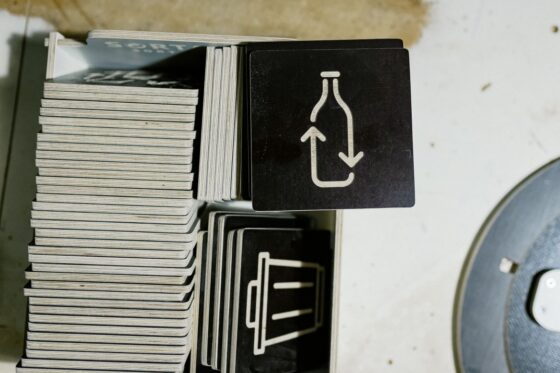
The name, colour and pictogram of the same waste fraction are kept the same in classrooms, corridors, dining areas and in the waste management instructions of the property. The marking is set so that the user sees it before leaving the waste. The instruction does not promise an automatic change of behaviour; it makes the property’s own sorting structure visible.
A checking and emptying responsibility as well as a waste sack suitable for the use are determined for each point. The exact bag size is checked on the product page of that model. Sorta products are delivered glued, fully assembled and packed. The first waste bags are included, so commissioning does not require assembling the product at the site.
School recycling bins from the Sorta range
Once the number of waste fractions, the volume of the compartment, the colour, the location and the maintenance route have been defined, the next step is choosing a suitable model. In the Recycling bins Sorta for schools category you can compare brown and white 20, 40, 60 and 90 litre Sorta models for 2–5 waste fractions, prices and product information.