Office recycling bins from the workstation to shared spaces
Office recycling bins work best when their size, the number of waste fractions and their placement match the daily use of the space. An individual workstation, a meeting room, a break room and a sorting point shared by a whole floor need different capacity and different waste fractions.
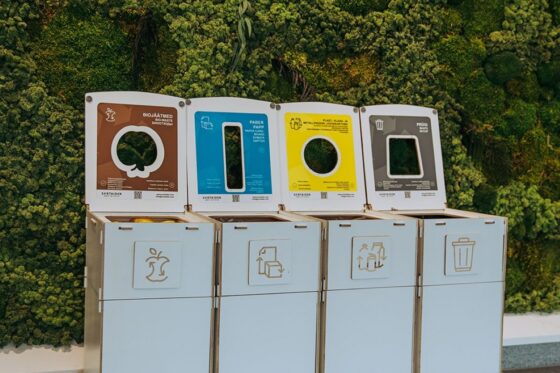
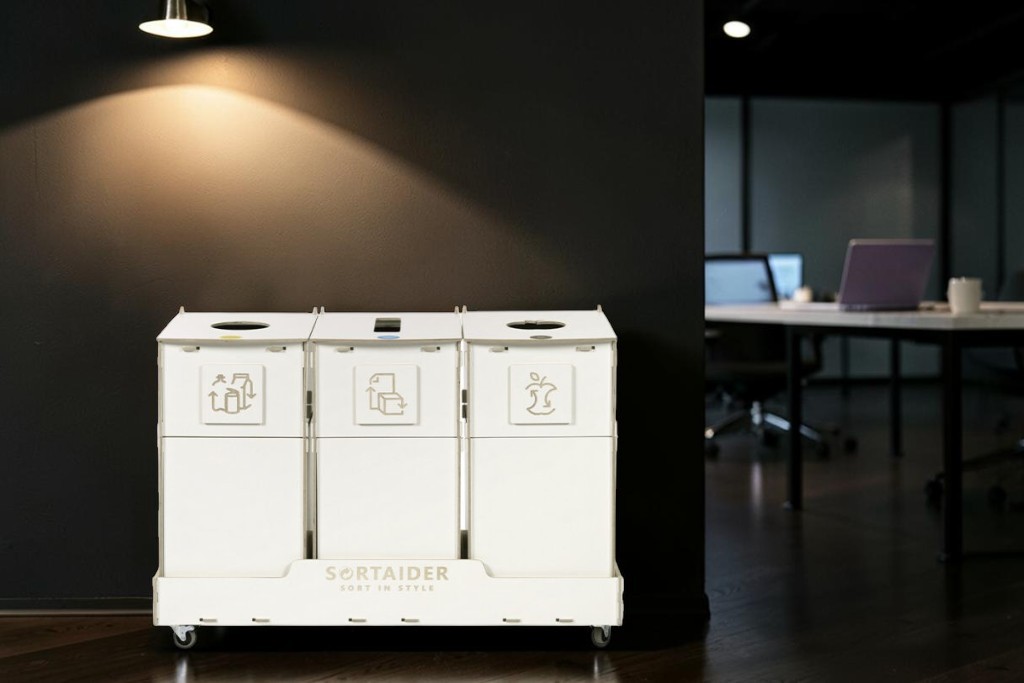
The Sorter series range includes bins of 10, 20, 30, 40, 60 and 90 litres as well as sets for 1–5 waste fractions. In this way the same sorting principle can be used from a small work room to a large shared space.
The placement of office recycling bins starts from where the waste is generated
The sorting point is placed where that waste is usually generated. When the bin is along a natural passageway and the waste fraction is clearly marked, the user does not have to look for the right bin in another room.
- At a workstation or in a small work room a compact point is usually needed for the waste fractions that are generated while working.
- In a meeting room the bin is placed near the refreshments or the exit route of the room so that it does not block movement.
- In a break room and kitchen space the sorting point is planned according to the bio and packaging waste and the mixed waste generated in the space.
- In a lobby, a corridor or a space shared by a floor the point has to be easy to find and to serve several users without sorting disturbing the passage.
One well-placed shared point can serve several nearby spaces. If different waste fractions are generated in different places, they do not have to be forced into the same point: the placement is decided on the basis of use, not of the floor plan alone.
The size of office recycling bins is chosen according to the amount of use
A suitable volume is estimated according to how much waste is generated between emptyings. The choice is made one waste fraction at a time, because paper, biowaste and packaging can fill the bins at a different rate in the same space.
- 10 or 20 l: for a workstation, a small work room or the sorting point of a limited group of users.
- 30, 40 or 60 l: for meeting rooms, break rooms and other shared spaces where waste is generated by the activity of several users.
- 90 l: for the shared sorting point of an open-plan office, a whole floor or other heavy use.
The volume is not chosen on the basis of the size of the space alone. The number of users, the waste fractions generated and the agreed emptying rhythm decide which size works in practice.
The waste fractions of office recycling bins are chosen according to the space
A sorting point for 1–5 waste fractions can be formed from the Sorter system. In each space only those waste fractions are used that are actually generated there and that are collected separately in the property.
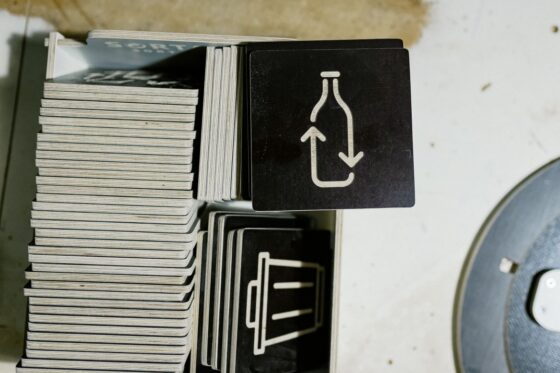
At a workstation, paper and mixed waste can be the necessary ones, for example. In meeting and break rooms, biowaste, plastic and cardboard packaging, metal or glass can be added according to the collection system of the property. The names and identifiers of the waste fractions are kept the same throughout the office, so that the same marking always means the same collection.
The number of waste fractions is not increased just to fill free bin space. A clear point contains the options that are necessary for the user and guides the waste into the right collection flow of the property.
A consistent system of office recycling bins supports maintenance
When the same bin series and the same waste fraction markings are used in different work spaces, the sorting points form a recognisable whole. The capacity and the number of waste fractions can change from one space to another without the principle of the whole system changing.
The modular Sorter system can be supplemented when the need of the space or of the waste fractions changes. Replaceable parts make it possible to renew a single worn part without changing the whole sorting point.
The bins are delivered assembled and ready to use. The first waste sacks are included, so commissioning does not require assembling the product at the workplace.
Office recycling bins from the Sorter range
Once the location, the volume and the waste fractions of the sorting point have been defined, the next step is choosing a suitable model. In the Recycling bins for offices and business premises category you can compare Sorter models on the basis of size, colour, 1–5 waste fractions and price.