Public space recycling bins Container for hospitals, clinics and lobbies
Public space recycling bins are planned according to the flow of users in the space, the waste fractions collected separately and daily maintenance. A hospital lobby, a clinic waiting area, a health centre corridor and other public indoor spaces need an easily found sorting point that does not make movement or cleaning more difficult.
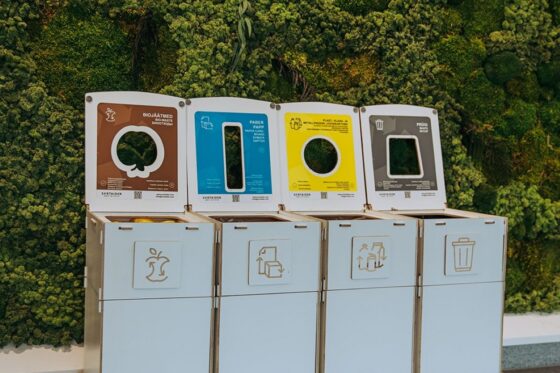
The basic models of the Container series consist of three, four or five 40 litre inner bins. The same structure can be fitted to different public indoor spaces by choosing the waste fractions needed at the site, a suitable location and a brown or white model.
The placement of public space recycling bins is planned according to the flow of users
The sorting point is placed where the user meets it naturally and where the waste to be sorted is usually generated. Enough space is left around the bin for use, for detaching the inner bins and for cleaning the surfaces.
- In the lobby of a hospital, health centre or clinic the point is placed on a visible route near the waiting area or the exit, without blocking the passage.
- In a waiting area the waste fractions are chosen according to the ordinary packaging waste and mixed waste generated in the space and according to the collection system of the property.
- In a corridor or next to an entrance the point can serve several nearby spaces when it is easy to notice and does not narrow the passageway.
- In a public cafe or service space the bin is placed near where the waste is generated, so that the user has time to identify the right waste fraction before leaving the waste.
The same placement does not automatically suit every building. The final place is checked on the basis of the flow of users at the site, the cleaning route and the property’s own waste management instructions.
The 3–5 waste fractions of public space recycling bins are chosen according to the collection system
Only the waste fractions that are generated in that space and that are collected separately in the property are chosen for a Container sorting point. A model for three waste fractions is enough at a site where there are few separate collection options. A model for four or five waste fractions suits a space where the user has to separate several packaging and other ordinary waste fractions.
The waste fractions can be, for example, mixed waste, biowaste and cardboard, plastic, metal or glass packaging. The names of the property’s own collection system are always used at the site: the marking of the recycling bin and the waste management instructions of the property must not give the user conflicting guidance.
The names, colours and identifiers of the waste fractions are kept the same at all Container sorting points in the same building. A clear marking tells what belongs in each opening, without the user having to interpret the structure of the bin.
The 40 litre dimensioning of public space recycling bins is checked according to the emptying rhythm
In the basic configuration of the Container series each inner bin is 40 litres. A set for three waste fractions is 3 × 40 l, that is 120 l, a set for four waste fractions is 4 × 40 l, that is 160 l, and a set for five waste fractions is 5 × 40 l, that is 200 l.
The model is not chosen on the basis of the total number of litres alone. The number of users, the filling speed of the different waste fractions, the agreed emptying rhythm and the space available at the location decide whether three, four or five waste fractions and one or several sorting points are needed.
If one waste fraction fills up faster than the others, the solution is checked according to the actual accumulation of that waste fraction. The number of the other waste fractions is not increased just to reach a larger total capacity.
The cleanliness of public space recycling bins is taken into account already in the placement
The smooth surfaces and detachable inner bins of the Container models make it easier to wipe the surfaces, empty the inner bins and change the bags. Lockable wheels make it possible to move the sorting point for the time of cleaning and keep it in place during use.
The sorting instructions are placed so that they are visible to the user before the waste is dropped in. The bag holders keep the bags in place in the inner bins and the edges of the bag inside the structure.
Container bins are delivered glued, fully assembled and packed. The first waste bags are included, so commissioning does not require assembling the product at the site.
Public space recycling bins from the Container range
Once the location of the sorting point, the number of waste fractions and the maintenance requirements have been defined, the next step is choosing a suitable model. In the Recycling bins Container for public spaces category you can compare brown and white models for 3–5 waste fractions and their prices.