Main Hall Recycling Bin

Eesti Keele Instituut
May 2024
Main Hall Recycling Bin for Waste Sorting
The main hall serves as the central artery and primary social hub of the educational institution, connecting all departmental zones, administrative offices, and public-facing areas. As the high-traffic nexus of the building, it experiences a constant, high-volume flow of occupants throughout the day. Maintaining operational standards in this space is critical, as it functions simultaneously as a transit zone, a waiting area, and the institution’s formal point of entry.
Operational Challenges
In our assessment of high-traffic building circulation, we identified that conventional waste management methods in the main hall often created operational bottlenecks:
High-Volume Accumulation: The central location attracts a diverse waste stream, including coffee cups, beverage bottles, promotional leaflets, and packaging. Inadequate or poorly placed disposal units lead to rapid overflow and increased litter, which directly degrades the institution’s public image.
Workflow Disruption: When disposal points are not aligned with the natural flow of human traffic, waste accumulates in transitional areas, necessitating more frequent and time-consuming cleaning interventions by facilities staff.
Professional Representation: The main hall acts as the “front office” of the institution. Industrial-grade, unsegregated waste bins are aesthetically incompatible with the professional standards required for an area that welcomes visitors and prospective students.
Strategic Implementation
To optimize the main hall environment, we prioritized infrastructure that balances high-capacity throughput with visual discretion:
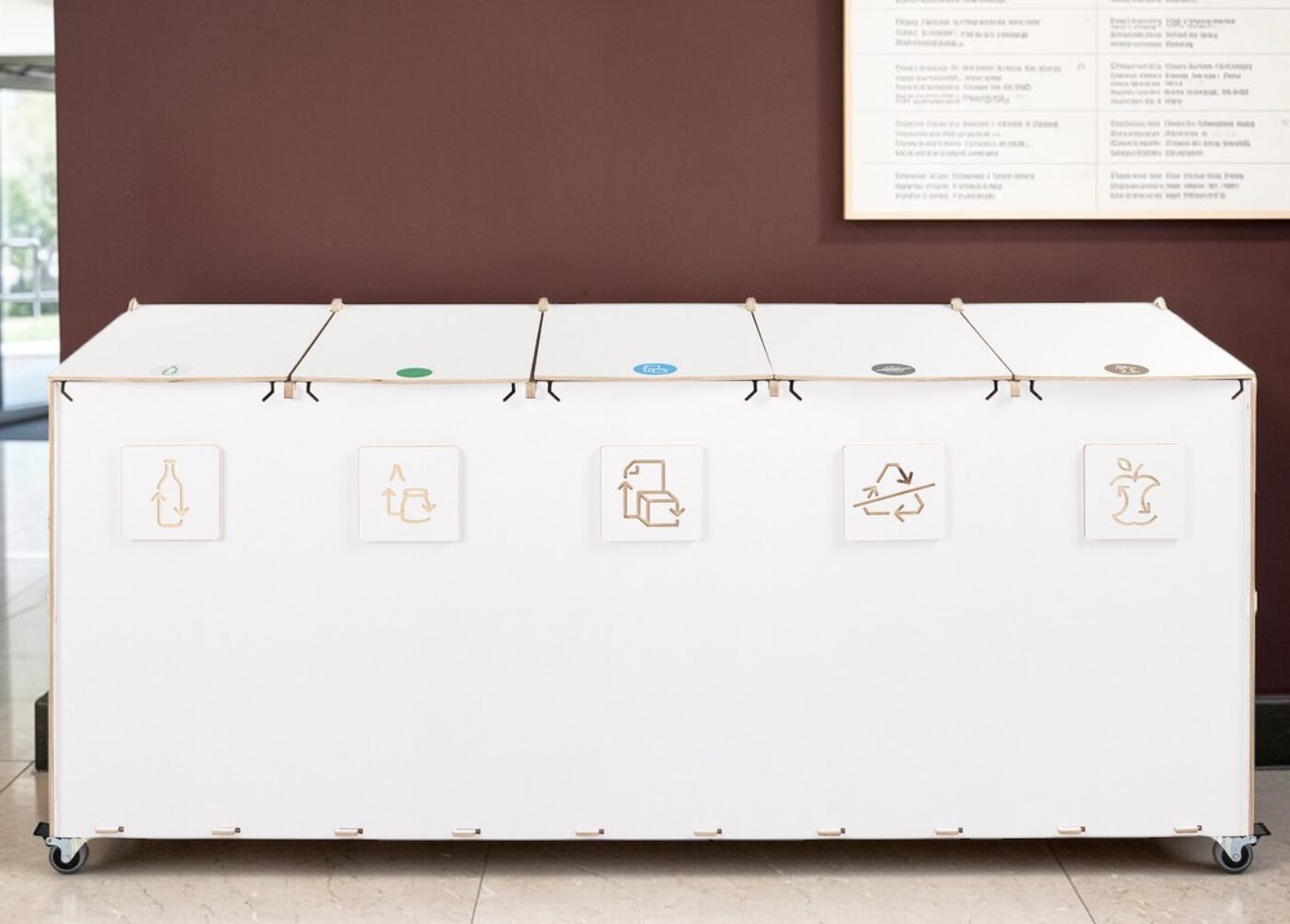
Flow-Aligned Positioning: Recycling stations are integrated into high-traffic circulation routes, specifically near primary entrances and transit nodes. This ensures that users can dispose of and sort their waste as an instinctive step in their movement through the building, minimizing stop-time.
Professional Design Language: We utilize high-performance hardware that integrates seamlessly with the hall’s architecture. The equipment is engineered to provide a sophisticated aesthetic that reinforces the institution’s commitment to quality, while remaining robust enough to handle intensive daily use.
Standardized Sorting Logic: Clear, intuitive stream identification reduces user confusion, ensuring that high-value recyclables are diverted correctly and the purity of waste streams is maintained, which significantly simplifies post-collection logistics.
Institutional Benefits
Implementing a standardized, intuitive recycling system within the main hall offers measurable operational and professional advantages:
Maintenance Optimization: By facilitating intuitive sorting at the source, facilities teams reduce the frequency of manual clearing and post-collection sorting, allowing for more streamlined facility maintenance.
Increased Recovery Rates: Positioning recycling as the default, convenient option for all occupants maximizes waste diversion and demonstrates a commitment to sustainability at the building’s core.
Institutional Stewardship: A professional-grade, organized, and clean entrance area reinforces the institution’s commitment to excellence, ensuring that the first impression provided to students, staff, and visitors is one of operational maturity and organized stewardship.
Effective waste management infrastructure in the main hall is a foundational element of institutional operational efficiency, ensuring that the building’s central hub remains clean, efficient, and professionally managed.
Client: Eesti Keele Instituut
Product video: Recycling Bin Sorta 90W5